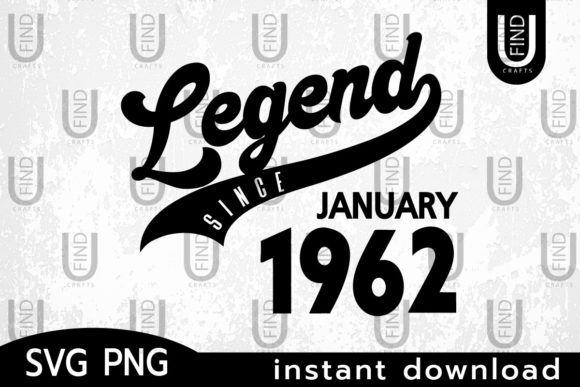
Vintage 1962, Legend Since January 1962
I have spent years evaluating embroidery designs for everything from boutique branding to high-volume custom apparel. When I first opened the files for Vintage 1962, Legend Since January 1962, I wasn't just looking at a retro graphic; I was immediately thinking about where this design would live in the real world. As a designer who values practical application over flashy marketing, my goal is to tell you exactly how this piece performs when it moves from a screen to a needle.
The first impression of Vintage 1962, Legend Since January 1962 is one of authentic nostalgia. The typography and layout scream "retro" without feeling like a cheap knock-off. It has a specific visual personality that fits perfectly into the Crafts and Graphics categories, but its true value lies in its versatility as a machine embroidery design. It doesn't feel like a generic birthday template; it feels like a badge of honor for someone born in that era. This mood is crucial because embroidery projects rely heavily on emotional connection. When a customer sees this stitched onto a garment or accessory, they need to feel that sense of timelessness immediately.
Real-World Application: The Custom Sweatshirt Scenario
Let's imagine a concrete scenario. You are an Etsy seller preparing a batch of personalized gifts for a client celebrating their 60th birthday. The client wants something unique, not just a standard "Happy Birthday" message. They want something that acknowledges their legacy. You pull up Vintage 1962, Legend Since January 1962 to stitch onto a heavyweight cotton sweatshirt.
In this situation, the design excels. The text "Legend Since January 1962" provides a strong focal point. When digitized correctly, the lettering likely utilizes a combination of satin stitch for the bold outlines and fill stitches for the body of the letters, creating a raised texture that feels premium against the soft fabric. Unlike some digital downloads that look flat or messy when stitched, this design appears to have enough negative space and clear spacing between characters to prevent thread breakage. It works beautifully as a chest placement or even centered on the back of a hoodie, acting as a statement piece that elevates a simple garment into a collectible item.
The same logic applies to other products. Imagine stitching this onto a canvas tote bag for a craft fair. The durability of the embroidery here is key. A tote bag gets handled daily, so the design needs to withstand friction. If the stitch density is balanced well, Vintage 1962, Legend Since January 1962 will hold up through countless washes, maintaining its crisp edges and legibility. It transforms a plain bag into a branded asset for a small shop product or a cherished handmade product for a family member.
Where Caution is Required
However, every professional knows that no design is perfect for every surface. While Vintage 1962, Legend Since January 1962 is robust, there are specific situations where you must exercise caution. If you attempt to use this design on a curved surface like a baseball cap, you need to ensure your hoop size matches the curvature of the hat properly. Small hoop sizes often struggle with larger text blocks, potentially causing distortion or puckering around the corners.
Fabric texture also plays a massive role. If you are working with thin, stretchy knit fabrics, such as a lightweight t-shirt or a baby onesie, the tension required for this design might cause the fabric to pucker. In these cases, using a proper stabilizer is non-negotiable. Without adequate backing, the weight of the fill stitches could drag the fabric down, ruining the drape of the finished product. Similarly, on dark fabrics, the contrast of the thread colors becomes critical. If the design relies on subtle details or small lettering, you must verify that the thread colors chosen provide enough visibility. A design that looks great on a white mockup might disappear if stitched in black thread on navy fabric.
Dense stitch areas are another consideration. If the design includes intricate decorative accents or very small details within the "Vintage 1962" text, those areas can become stiff and uncomfortable if the stitch density is too high. For items like aprons or kitchen towels, which require frequent washing and movement, overly dense embroidery can lead to cracking or peeling over time. Always inspect the design file to see if the small details are realistic for the intended medium. If the original vector shows tiny lines that cannot be rendered effectively by a standard embroidery machine, you may need to simplify the design before stitching.
Visual Appeal and Customer Trust
The quality of your embroidery directly impacts customer trust. In the world of commercial embroidery and handmade goods, clients expect professionalism. A sloppy stitch job or a design that doesn't align with the fabric grain can make a business look amateurish. Vintage 1962, Legend Since January 1962, when executed correctly, signals attention to detail. It suggests that the creator cared about the final result, which increases the perceived value of the item.
This design is particularly effective for giftability. Whether it is a holiday gift for a grandparent or a wedding gift for a couple celebrating a milestone, the theme resonates. It tells a story. When a buyer receives a personalized product featuring this design, they are not just receiving a piece of cloth; they are receiving a tribute to a specific moment in time. This emotional resonance drives engagement and encourages repeat business for crafters and small shop owners.
For digital product sellers, having a clean, versatile design like this allows for better printable mockups. You can showcase the design on various backgrounds—light, dark, textured—to demonstrate its adaptability. This helps potential buyers visualize the finished product before they purchase the digital embroidery file.
Practical Designer Notes for Success
Before you commit to a full production run or sell this design commercially, there are essential steps you should take. First and foremost, always test the design on scrap fabric. This is the only way to confirm how the stitch density interacts with your specific machine and thread choice. Check the thread color contrast by stitching a swatch in black and white mockups, then move to actual colored threads to see the true effect.
Review the stitch density carefully. If the design feels too heavy, consider adjusting the settings or simplifying the fill areas. Confirm the hoop size requirements early on to avoid mid-project headaches. Inspect small details closely; if the resolution is low, the text might appear jagged when enlarged. Use proper stabilizer for the fabric type you are working with, especially for stretchy materials like baby clothes or athletic wear.
Finally, check the licensing terms. Ensure that you have the right to use Vintage 1962, Legend Since January 1962 for commercial purposes if you plan to sell finished items. Many digital downloads come with restrictions that prohibit resale of the physical product. Verify whether the listing allows for unlimited commercial use or if there are caps on the number of units you can produce. By following these practical steps, you ensure that your project remains profitable and professional.
Ultimately, Vintage 1962, Legend Since January 1962 is a strong candidate for any crafter or designer looking to add a touch of vintage flair to their portfolio. It balances aesthetic appeal with functional embroidery requirements, making it a reliable asset for custom apparel, embroidered patches, and personalized gifts. Just remember that the success of the final product depends on your preparation and understanding of the materials involved.